Ethanol
About This Product
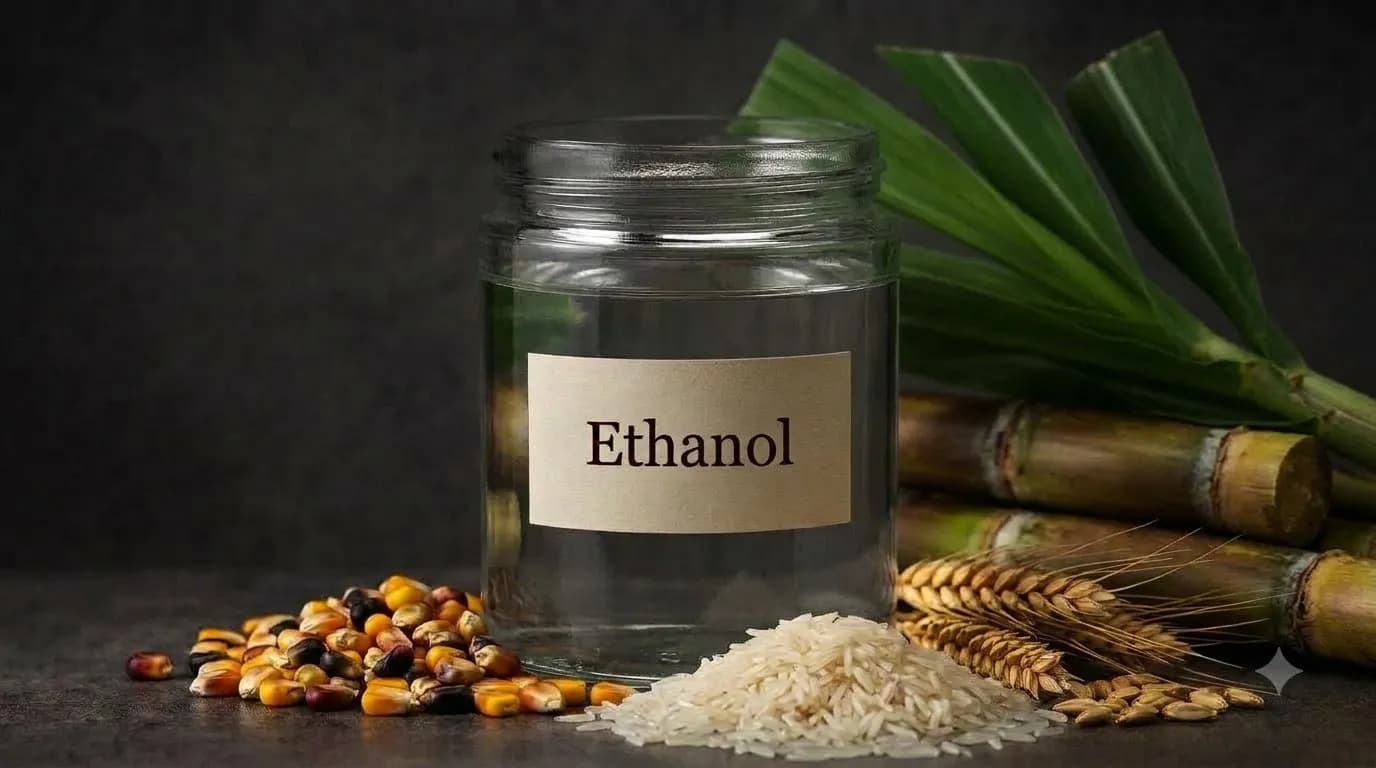
Fuel ethanol is produced by fermenting sugars from sugarcane, corn, wheat or cellulosic residues, then distilling and dehydrating the product. Anhydrous grade, above 99.5 percent, is the material blended into gasoline and is specified to EN 15376 in Europe and ASTM D4806 in the United States. Hydrous grade, around 95 percent, is used directly as a fuel in dedicated engines, principally in Brazil. Two properties define how it is used. It has a research octane number well above gasoline, so it is valuable as an octane booster and as the replacement for tetraethyl lead and MTBE, and it carries oxygen within the molecule, which improves combustion completeness. Against that, ethanol is fully miscible with water and strongly hygroscopic. If a blended fuel picks up enough moisture the mixture phase-separates, with the ethanol and water dropping out as a distinct layer that an engine cannot run on. This is why ethanol is not shipped in multi-product pipelines and is instead blended at the terminal immediately before distribution. It also has about two thirds the energy density of gasoline by volume, so fuel consumption rises as the blend ratio rises. It is used in E5, E10, E85 and E100 fuel blends, as an octane enhancer, in ETBE production and as an industrial solvent. Bio Green Fuels supplies fuel ethanol to specification on ethanol content, water, methanol, acidity, chloride, copper, sulphate and appearance, with ISCC certification available.
Applications
Indicative price: $1.00–8.50/kg
Indicative bulk guide only. Prices are market-linked and updated regularly - please request a quote for current pricing and volume rates.